Memory: Erasure, Values and SEL as a meditation on what it means to be truly Japanese

"It's a story from 20 years ago, so it can't be helped that everyone's memories are confused."
-Chiaki J Konaka, discussing SEL's plot,
Lain Anniversary blog on hatena.jp, 2018.
-----------------------------------------------------
SEL is a classical Japanese Kaidan story, typically told as an anthology of the strange and the mysterious. Kaidan's are not to be confused with Western ideas of "horror", and have more in common with "creepypastas" or strange , odd stories from hearsay.
From the "hyakumonogatari" blog:
" The first kanji in kaidan, 怪 (kai), means weird, strange or mysterious. Like the kanji 霊 (rei), 怪 is a kanji that makes several appearances in Japanese folklore, the most important being in the aforementioned word 妖怪 (yōkai) which combines 妖 (yō) meaning attracting or bewitching with 怪 (kai). Yōkai is the term used for Japanese folkloric monsters like the water-dwelling kappa and mountain-dwelling tengu. The second kanji in kaidan is 談 (dan), means to discuss or talk. The kanji carries the nuance of transference of information, of passing from one mouth to another, and is found in words such as 雑談 (zetsudan) meaning idle chatter.
The most literal possible interpretation of kaidan would be something like a discussion or passing down of tales of the weird, strange or mysterious. Personally, I prefer to either use the word as it stands, kaidan, or if I must put it into English I take a page from Irish author Sheridan Le Fanu, most famous for his lesbian-vampire story Carmilla (1872), and who called his stories of the supernatural and sublime weird tales. I like the term weird tales for both the nostalgia it invokes and the nuance of the type of story the reader expects, somewhat similar to kaidan."
SEL then functions as a typical "weird tale", telling a very classical Kamikakushi structure where a person, often a child, is "spirited away" out of existence, taken from the material realm apparently on the instructions of the divine, that is Kami. However, in SEL, this takes place in a modern setting, late 90's Japan, where Chisa is "spirited away" into the internet by the God of the Wired, while the story reverses this by the last episode, undoing Chisa's Kamikakushi and having Lain Iwakura herself be actually spirited away, forgotten by all near and dear into the spirit world, by the real god all along.
Presence via absence
Kamikakushi, the Japanese term for individuals who have been "spirited away" is not merely a word for description, but a cultural attitude to the resolution of stories and events.
"
The core definition of kamikakushi, here as in other sources, is the sudden and mysterious disappearance of individuals due to their abduction by some supernatural being.
Yanagita adds the following details: (1) Those abducted
were often boys or young men; (2) Only if the missing person was not found during an extensive search by neighbors and relatives and did not reappear after a few days, people spoke of kamikakushi; (3) The abducting supernatural being was usually explained as some mountain dweller, deity or tengu 天狗—a large human-like creature with a beaked nose and wings and often associated with mountain ascetics;3 (4) The danger of kamikakushi was particularly high in winter and during the harvest season; (5) Typical locations for kamikakushi were areas where human civilization bordered on uninhabited forests, mountainous
regions or streams; (6) Some of those abducted returned, either as half-wits or to tell stories about wondrous journeys to strange countries.
Thus, kamikakushi was often the somewhat consoling belief that a missing family member had not met with a dreadful accident, but been taken on a long and interesting journey and might even return some day. Defining a missing person as having met with kamikakushi had the additional significant psychological effect of ending the period of anxious searching, allowing relatives to
deal with their loss and to name and blame a culprit."
- Virtual Kamikakushi: An Element of Folk Belief in Changing Times and Media, Birgit Staemmler
The idea of a "lost person" being somewhere still out there and who may return one day is an incredible point, because we have SEL make this imagery very obvious, along with nods to similar iconography from its two major religious inspirations, Buddhism and Christianity.


Layer 13, the first time we are reminded of Lain's seeming absence not completely forgotten is when her "dad" i.e Yasuo Iwakura looks at her chair and struggles to remember

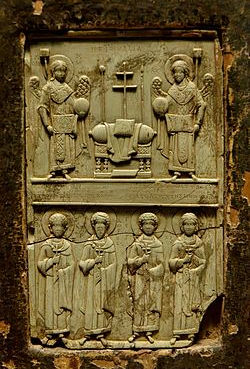
Early Christian and Buddhist Art from Medieval Italy and Ancient India respectively have always depicted their respective central figures as "absent presences", most incredibly through the "Hetoimasia".
The symbol is that of an empty throne waiting to be (re)occupied by a king. In both philosophies, Christ ascended to Heaven and the Buddha to Nirvana, but they persist in the memory of their disciples and will one day return to reclaim their rightful place


Another example of aniconism in both early Buddhist and Christian art are the "BuddhaPada" and "Chi -rho" respectively. While the BuddhaPada from Early central India clearly shows Buddha's dharma persisting through his footprints despite his existence being absorbed into Nirvana, the Chi-Rho shows christ as a figurative symbol whose order will persist despite his death and will go on to do so.
In both cases, the memory of their respective teachers are remembered through their symbolic absence in the material realm.

Aniconism in artistic depction, though rare in both religions, was far more common in Buddhism than Christianity, although this trend was mostly constricted to India, the land of its origin. Here, the Buddha was originally depicted as a spectral memory sweeping the landscape through the clever use of symbols: A royal horse without a rider, a parasol caught in the wind, a Bodhi tree with nobody meditating under.
In this manner, the Buddha paradoxically exists through his non-existence and persists in doing so. This is in line with Buddhist teaching, for the future buddha, the Maitreya, is said to return the dharma to order when the teachings of the master have all but been completely forgotten.
We then see what the SEL culture war really hinges on: the mourning for a country that once was and which has all but lost its way, and yet as a ghost that haunts the landscape, may one day return to the world of the living.
Yet why does SEL make these dramatic claims? Isn't Japan still a largely proud country that cherishes its' Japanese-ness and its cultural purity?
Maybe so, but there could also be a deeper narrative running beneath this? What are the values that have been lost? What was this mysterious land once upon a time? How did they lose it?
False values among us

The "culture war" of Ueda, Konaka and Ryutaro is evident throughout the show, but only if you keep your eyes peeled.
One great example is the Japanese view of Children. In Japan, the term for children is "子宝", meaning "child treasures", or "the treasures that are our little children". In many East Asian cultures, particularly due to the not so insignificant amount of Confucian influence, children were the jewels of a community's life. Parents lovingly made little bento boxes full of treats that their children could take to school, while villagers kept a watch on them as they went to school, a practice called "koutou-anzen-sha". This is a greater derivative of the principle of Oyakoko (which translates to "parenting together") a belief that all adults in the community have a shared duty in taking care of little ones, including those that aren't their own, treasuring them for who they are and ensuring their growth to be better.
Yet the episode title Kids puts this under a microscope. Throughout SEL, we see a very intentional depiction of collective apathy to the wellbeing of children. Lain's mother Miho doesn't care about why she was in the police station in episode 2, Alice with her friends is not eating bento but fried junk and chips while discussing the Knights in episode 5, and Taro and gang are running amok since episode 2 in questionable spaces without any adult supervision.
This is surprising, until you point out that the dominant culture of the planet at the moment is American, a culture which can storm its government buildings over a "fraudulent" election but doesn't care when children are being killed by firearms in schools, eat crap for food and drink insane liters of soda and are also Kamikakushi'd to be diddled on certain Islands.
What is being depicted is obvious:
"When did we Japanese adopt these American values and stop giving a shit about our kids?"
Another throwaway is given in the scene of the Knights' in layer five, during the
Ukiyo-e painting sequence. The knights are clearly a reference to phenomenae of domestic actors being captured by Foreign interests and being instrumentalized to push an agenda. Japan's netto-uyoku, a far right nexus on 2chan, is one more modern example.
2channel/2chan, the direct inspiration behind 4chan, is the central site for political discourse on Japanese internet, and it was so popular that even some important political figures have had accounts there. It was first started by a Japanese student who was studying in the University of Arkansas in 1999, named Hiroyuki Nishimura, and it then bloomed in popularity, to the point where a not-so-insignificant amount of the entire countries' discourse was happening on it.
Yet 2chan had a growing problem, the netto-uyoku, an ultranationalist section of the Japanese internet, who were rabid disgruntled individuals arising from the economic blowout of the Lost decades. In Japan, societal harmony and conformity is the ultimate virtue, not freedom of expression, and the government thought to curb it. However, despite 2chan being the central node of the Japanese internet since the late 1990's, both the server and domain were hosted in San Francisco California till 2014 under Jim Watkins, a fomer US military official and QAnon conspiracy theorist. Thus the Japanese culture discourse is now being controlled by infrastructure built in America and prone to interference by Americans
Although this sort of blatant interference may be surprising, its' not uncommon in Japan. For example, many of Japan's most prized citizens (including two princesses of the Royal family, the first Japanese man in space and the head of Sony's technology divison who also created the AIBO robot dog) went to study in the "International Christian University" in Mitaka, Tokyo. So noting the fact that the university's funding mostly came from non-christians (95% according to its' website), that Christians are an exceeding minority in Japan (less than 2%), and that the primary chair of the US funding for ICU was Douglas Macarthur, the chief occupying general of Japan post WW2, the ICU states that:
"The College of Liberal Arts holds as its mission the establishment of an academic tradition of freedom and reverence based on Christian ideals, and the education of individuals of conscience, internationally cultured and with a strong sense of citizenship in a democratic society"
Now, the historical allusions become increasingly clear. Christians in Japan were always treated with deep suspicion as a force that created a ruckus in Japan's communal harmony. The Shimabara rebellion comes to mind, the largest civil conflict in Japan's Edo period during which there was normally little civil unrest, historically.
Kuniyoshi, the Japanese Ukiyo-e painter who depicted the brave suikoden, is emblematic of a deeper cultural reverence for heroes against tyranny and oppression. "Suikoden" is a Japanese translation of the Chinese novel "Water Margin", where a group of brave bandits and outlaws rebel against a tyrannical and oppressive government become clear, and the story was so popular they became ukiyo-e paintings, yakuza tattoos and samurai emblems in Edo era Japan.
But now instead of outlaws, the bandits have become "knights", pathetic yet useful tools of vested foreign interests. The larger Japanese public, as well, has become completely indifferent to these very obviously alien invaders, much like how Americans are largely indifferent to child-eating pedophile billionaires lording over them and instead choose to slobber over Bad bunny Superbowl performances.
Alice spells it out in Layer 3: the incident of the Accela kid getting shot was happening right in front of them, but it didn't feel real and was like watching a movie. They were slowly, through media and consumerism, conditioned to become apathetic.
The question is clear:
"When did we lose our reverence for honour and bravery, for figures such as the Suikoden and Musashi Miyamoto fighting against injustice and tyranny, and have instead turned into apathetic Americans glued to the TV? What happened to our society?"
The symbolism of religion in SEL: Christian Dyaus and Buddhist Kishimojin

Japan is 40% Buddhist and less than 2% Christian. This may seem like a throwaway statistic being inserted as an introduction to this section, but it seemed necessary to put this fact out there to examine what exactly the role of christian and buddhist symbolism in SEL is. The answers are clear when we begin to realize that SEL directly uses Christian imagery not in a manner of respect, reverence or coolness, but in an act of direct antagonization, much like Berserk, Fullmetal Alchemist 2003 and many more.
The bad guys are the Christians trying to bring us under the fold of one truth, one reality, one new world order.
In contrast, Japan's form of Buddhism, Shinbutsu-Shogo, was one that espoused a fusion of both Buddhist values and native Shinto traditions, resulting in a syncretism that preached the tolerance of the different. It's no coincidence that Japan, pre-western influence and Meiji restoration, had a completely different attitude to the Ryukyuans (now called "Okinawans") and towards nature (the Japanese diet was nearly devoid of meat at one point in history). This primarily due to Buddhism's relation to truth, where even the Buddha doesn't claim his word to be infallible, unlike Christ who proclaims eternal law under his words. One allows for diverse opinions, paths and attitudes to flourish, while other decries all but itself as impure and wrong.
Kannon (the Japanese manifestation of Avalokiteśvara) is one of the most beloved bodhisattvas in East Asian Buddhism, revered as the embodiment of infinite compassion who hears the cries of all sentient beings and responds to their suffering with wisdom and mercy. Originally deriving from the Indian bodhisattva Avalokiteśvara, Kannon's image evolved as Buddhism spread through China, Korea, and Japan, gradually absorbing local religious traditions and taking on diverse forms suited to different devotional contexts.
Among these manifestations is the fascinating association with Kishimojin (Sanskrit: Hārītī), a deity whose transformation from child-devouring demoness to compassionate guardian illustrates one of Buddhism's most powerful narratives of moral redemption. Originally, Hariti was a local god in Indian folk religion, largely depicted as an eater of children for sustenance (a convenient explanation for missing children). According to later Buddhist tradition that sought incorporate these local faiths under the fold of the Dhamma, a story was told to reform the godess and goes as follows:
Hārītī was a yaksinī (demoness) who had hundreds of children of her own but sustained them by abducting and consuming the children of others. Desperate parents appealed to the Buddha, who devised a lesson rather than punishing her outright. Secretly taking Hārītī's youngest and most beloved child, Pingala, and hiding him beneath his alms bowl, the Buddha allowed her to experience the anguish that countless families had endured because of her actions. Frantic and grief-stricken, she searched everywhere before finally approaching the Buddha for help. He asked how she could be overwhelmed by the loss of a single child when she herself had inflicted the same suffering upon innumerable parents. Confronted with this realization, Hārītī was filled with remorse and abandoned her violent ways. She vowed never again to harm children, became a devotee of the Buddha, and was entrusted with the protection of children, mothers, childbirth, and family welfare.
In Japan she came to be known as Kishimojin, where she is frequently depicted holding a pomegranate, a fruit whose many seeds symbolize fertility and abundance while also replacing the flesh of children as her source of nourishment. Over time, Japanese Buddhist traditions increasingly emphasized Kishimojin's role as a compassionate maternal protector rather than her demonic origins. This evolution naturally brought her into close symbolic relationship with Kannon, whose boundless compassion represents the ideal toward which Kishimojin's transformation points. In several Japanese traditions and temple contexts, Kishimojin is interpreted as an emanation, manifestation, or protective aspect of Kannon, sometimes referred to as Kannon-Kishimojin.
Rather than representing two separate deities fused into one, this association reflects the Mahāyāna Buddhist understanding that enlightened compassion can manifest in many forms according to the needs of sentient beings. Kishimojin's terrifying past is not erased but reinterpreted as evidence that even the most destructive beings possess the capacity for awakening and transformation through compassion and insight.
As Kannon-Kishimojin, she embodies both maternal tenderness and fierce protectiveness, serving as a guardian who shields children, grants safe childbirth, protects families, and wards off illness and misfortune. Her story ultimately demonstrates a central Buddhist principle: genuine compassion is not an innate privilege reserved for the pure but a quality that can emerge through profound self-reflection, empathy, and moral transformation, making Kishimojin one of the clearest examples of redemption within the Buddhist tradition and a compelling complement to Kannon's universal ideal of compassionate salvation. Lain Iwakura is a typical tale, of the Earthly form of Kishimojin, Reckless yet Just, ultimately undergoing the process of enlightenment to become the Boddhisattva ideal of Kannon, Pure Compassion for the welfare of life itself in its children.
Fruits play a very important cultural role in Japan, going from simple snacks into highly prized cultural and ornamental artifacts. Royal fruits such as Tachibana Oranges represent imperial hegemony, Royal decree and fragrance of memory, going so far as to be printed on the 500 yen note. As a symbol, Tachibana is a symbol of governance and the pinnacle of Japan, but it is also a stand in for Apple, the fruit of knowledge, the greed for deeper understanding that leads to the fall of man into sin and despair. In contrast, Kannon-Kishimojin hold a pomegranate, a symbol of renouncing violence, motherhood and fertility: Life itself. Japan must renounce shallow understanding, and move to live wisely.
SEL is a tension between Deus and Kannon-Kishimojin. The Wired is meant to be an Eater of children, a consumer of flesh, a system that draws upon human suffering for its extension and existence. Much like the myths of ancient Greece, where Kronos eats his Children just Ouranos, his own father, did, the show posits this sort of strange tension: Will Japan continue the path of Deus, a black-box prison of suffering where all children continue to be tortured? Or will it go the path of Lain, a reckless Kannon attaining her buddhist Idealin Kishimojin? A ruthless patriarchal capitalism that demands sacrifice with no reward , or a return to the memory of a loving mother culture, one who gives love unconditionally without expectation, to the point where it is taken for granted?
The Post war re-networking of Japan
Although the American Occupation formally ended in 1952, its influence on Japanese urbanism extended far into the postwar economic miracle, fundamentally altering the spatial organization of everyday life. The dense, mixed-use urban fabric of prewar Japan—characterized by machiya townhouses, neighborhood markets, family-run businesses, temples, workshops, and tightly knit communities—was increasingly transformed by a new urban order centered on mass housing, suburban development, and consumer capitalism. These were taken under the direct command of the overseeing military occupation.
The post-occupation housing shortage led the Japanese government to establish the Japan Housing Corporation (Nihon Jūtaku Kōdan) in 1955, which introduced large-scale residential developments known as danchi (団地). These modern apartment complexes were designed around standardized layouts, new domestic technologies, and the ideals of the nuclear family, as detailed in the Government of Japan overview of housing initiatives. These developments represented a dramatic shift from older neighborhood structures, replacing organically evolved communities with planned residential environments influenced by modernist architectural principles and standardized housing models that emphasized efficiency, privacy, and rationalized living.
Alongside danchi, the expansion of privately developed residential land (minchi, 民地) and detached suburban housing (ikkodate, 一戸建て) transformed the relationship between home, work, and community. New residential subdivisions increasingly separated living spaces from commercial and industrial activity, encouraging commuter lifestyles organized around railway networks and, increasingly, automobiles. These developments reflected Japan's transition into a mass consumer society (taishū shōhi shakai), where the household became a central site of modern consumption, equipped with the emerging symbols of postwar prosperity: television, refrigerator, and washing machine
By the 1970s and 1980s, the emergence of the konbini (コンビニ, convenience store) further transformed Japanese urban life. Although inspired by the American convenience store model, the Japanese konbini evolved into a uniquely integrated urban infrastructure, providing not only food and household goods but also financial services, parcel delivery, ticketing, and other everyday functions.
Seven-Eleven Japan, which introduced the American convenience store format through a licensing agreement in the 1970s, adapted the model to Japan's dense urban environment through advanced logistics, small-format stores, and highly responsive supply chains—a transformation documented in the Harvard Business School Seven-Eleven Japan Case Study.
Together, minchi, danchi, and the konbini became the architectural and commercial infrastructure of Japan's postwar consumer society, replacing localized systems of exchange and neighborhood-based social life with standardized spaces optimized for commuting, convenience, and continuous consumption. Rather than simply introducing new building types, these developments fundamentally reorganized everyday existence:
-
The home became a private consumer unit,
-
The neighborhood became a planned residential zone, and
-
Commerce became an always-available service network.
In this sense, postwar Japanese urbanism represented not merely a physical reconstruction after wartime destruction, but a transformation of social space itself, embedding the logic of industrial capitalism and mass consumption into the built environment of everyday life.
Television specifically became critical. By the 90's, Japan became a world leader in TV consumption. As far back as 1982, almost 40 years ago,the average Japanese person was spending 8 hours a day in front of the TV. Videotainment was so popular, the Japanese even pioneered VCR and their associated tapes. By the time Serial Experiments Lain was broadcast, it could be argued that almost the entirety of Japan lived their lives through the televison, as it organized their daily rituals, relationships, and -as we will see later- their very understanding of themselves.
Media and Censorship in Japan
Layer 9 opens with a strange event: a mysterious spacecraft crashes near Roswell, New Mexico, only for the incident to be immediately concealed from the public. The significance of such an event can hardly be overstated. If humanity were to encounter intelligent extraterrestrial life, it would undoubtedly rank among the most consequential discoveries in human history. It seems almost impossible to imagine such an event being successfully hidden. After all, isn't Roswell commonly dismissed as nothing more than a collection of conspiracy theories, UFO enthusiasts, and government paranoia?
Yet, in a sense, this is precisely the historical irony that Serial Experiments Lain invokes.
For almost seven years after the atomic bombings of Hiroshima and Nagasaki, the Japanese public possessed only a fragmented understanding of what had actually happened. While newspapers initially reported that a "new type of bomb" had been used, the full implications of nuclear warfare—the unprecedented destructive power of atomic weapons, the long-term effects of radiation sickness, and the horrifying medical consequences suffered by the Hibakusha—were systematically obscured.
During the American Occupation (1945–1952), the Civil Censorship Detachment under General Douglas MacArthur imposed extensive controls over the Japanese press, suppressing photographs of the bombings, confiscating film footage, restricting discussion of radiation poisoning, and censoring survivor testimonies that might cast the United States or the Occupation in a negative light. To many ordinary Japanese, the bombings remained an incomprehensible catastrophe rather than a fully understood technological and political event. Only after the Occupation ended in 1952—and especially following the 1954 Daigo Fukuryū Maru (Lucky Dragon No. 5) incident, in which Japanese fishermen were irradiated by fallout from an American hydrogen bomb test at Bikini Atoll—did nuclear weapons become the subject of widespread public discussion and collective national trauma.
The comparison to Roswell is therefore not meant to suggest that Hiroshima itself was a conspiracy theory, but rather to highlight a shared cultural anxiety: that events of world-shattering significance can be hidden, sanitized, or quietly absorbed into official narratives before society has fully processed what has occurred. In both cases, the public is left with fragments, rumours, and incomplete explanations while institutions determine what may or may not be known. Whether the subject is an alien encounter or the first use of nuclear weapons, the unsettling possibility remains the same—that history itself can be selectively remembered, carefully managed, and politically rewritten through instrumentalization of the mass media system.
This motif appears repeatedly throughout postwar Japanese popular culture. Neon Genesis Evangelion, for example, satirizes this very mechanism by presenting the cataclysmic "Second Impact" of the fast moving undetected meteorite crashing into Earth as the explanation for a global disaster whose true origins (a highly classified alien being's thermonuclear body becoming a bomb blowing up) are deliberately concealed from humanity. Beneath the language of scientific accidents and natural catastrophe lies a hidden history involving extraterrestrial beings, secret organizations, and state-sponsored deception.
Odin's Ravens consist of Huginn and Muninn: Thought and Memory. The use of Ravens and TV in SEL's opening, both being associated with Lain iwakura, is not a simple coincidence. Rather, the accusation is obvious: Japan has become systematically terraformed not only by the physical scars of occupation, but also the mental domestication of its citizens, to point of total and complete successful American assimilation. Japanese memory , and thus its self conception has been altered.
Art as a metacognitive meditation device
In his essay "Art and Cognitive Evolution", Cognitive Scientist Merlin Donald argues that art should not be understood merely as aesthetic expression, but as a form of cognitive technology: a material structure created by human beings to externalize, preserve, and reorganize knowledge across generations. Within this framework, artworks function as crystallized artifacts of a distributed cognition system ( a mind network that underpins human society), where culture itself acts as an external memory architecture that stores the experiences, anxieties, values, and conceptual frameworks of a society. Just like how a to-do list acts as an extended cognition system for the individual to make daily task allocation simpler, Artworks act as the nodes of self consciousness in collective self-cognition. Through artwork, artefact and tradition, cultures understand what makes them unique and how they are different, their civilisational values. The intention of referencing Project Xanadu as a speculative global memory computer system as well as the evolution of the wired from phones to Tv to the Net accompanying human evolution in the Show becomes direct.
Media systems allow for civilizations to extend their collective self understanding across their geographic boundaries. They can send their "eyes and ears" far further than normal. However, when these media systems get captured by external forces, what is perceived and remembered is altered, configured, sometimes even erased. If a tree fell in a forest, would anyone remember?
Viewed through this lens, Serial Experiments Lain can be understood as a metacognition artifact, a way for a culture to think about how it perceives itself and understand its dynamic nature. In zen Japanese Buddhism, a Koan is usually a paradoxical confusing statement used to break the conceptions of the disciple in order to reach an understanding he cannot ordinarily reach with his present mind. The story is a fictional work, but it allows you to perceive patterns that you would not normally. It's a mental tool for seeing things you are used to ignoring, and thus a fictional artwork like SEL can be more "true" about the underlying reality of things as they actually are in content than a simple photograph, video vlog or diary about the form of life in Japan.
In the earliest traditions of Buddhism, Dharana and Bhavana make up the precepts that create the basis of meditation, where the first means to concentrate and the second is to ponder, investigate and to analyze. Therefore, real meditation consists of the one-pointedness of mind and the power of analyzing. The practice of these make the form of meditation: Vipassana and Samatha, where they are purest forms of Dharana and Bhavana. But this analysis, unlike that of a scientist, looks inward, the inner state of being and one's essence.
Fundamentally, this is an exercise in valuing the Japanese concept of innen (因縁). This is the fundamental understanding that human beings, across time and space, are connected through a web of circumstances and causal connections that supersede any single individual and can be scarcely understood by one of many. To value innen is to not only value here and now in view of the ties that bind all people, but to recognize the forces that have brought us all together in this large web of interconnected events. We are all connected, no matter how many degrees separate us.
SEL is this a collective meditation on Japan and its relationship with America through the mass media network, and what the implies for the near future. Will Japan be able to remain Japanese even as America rewrites its historical self understanding? It's not like America's rewriting is even a secret. The US government even lists it openly on its own website.
“Like all technical images, photographs are concepts encoded as states of things, including photographers' concepts such as those that have been programmed into the camera. This gives photography critics the task of decoding these two interweaving codes in any photograph. Photographers encode their concepts as photographic images so as to give others information, so as to produce models for them and thereby to become immortal in the memory of others. The camera encodes the concepts programmed into it as images in order to program society to act as a feedback mechanism in the interests of progressive camera improvement.
If photographic criticism succeeds in unravelling these two intentions of photographs, then the photographic messages will be decoded. If photography critics do not succeed in this task, photographs remain undecoded and appear to be representations of states of things in the world out there, just as if they reflected 'themselves' onto a surface. Looked at uncritically like this, they accomplish their task perfectly: programming society to act as though under a magic spell for the benefit of camera”
-Flusser, Towards a philosophy of photography.
“A capitalist society requires a culture based on images. It needs to furnish vast amounts of entertainment in order to stimulate buying and anesthetize the injuries of class, race, and sex. And it needs to gather unlimited amounts of information, the better to exploit natural resources, increase productivity, keep order, make war, give jobs to bureaucrats.
The camera's twin capacities, to subjectivise reality and to objectify it, ideally serve these needs as strengthen them.
Cameras define reality in the two ways essential to the workings of an advanced industrial society: as a spectacle (for masses) and as an object of surveillance (for rulers).
The production of images also furnishes a ruling ideology. Social change is replaced by a change in images. The freedom to consume a plurality of images and goods is equated with freedom itself.
The narrowing of free political choice to free economic consumption requires the unlimited production and consumption of images.”
― Susan Sontag, On Photography
"
Assume that a civilisation is dead and no one knows the language once spoken by its subjects. Although the books written in that extinct language survive, no one is capable of decoding them and the connection is thus lost between the defunct culture and the actual social-cultural process, including the cognitive one. And that means that the books preserved no longer contain any knowledge. Properly speaking, they are not even books but simply objects with strange strokes in them.
Cognition is implemented by real persons, by concrete individual subjects. Knowledge in subjective or objectified form exists only inasmuch as it is directly or indirectly correlated with that activity. At the same time, the cognitive activity itself should be regarded on the social-historical plane, as activity of interconnected subjects — past, present, and future. For this reason, if certain fragments of objectified knowledge are not consciously realized by a single existing subject; that does not mean that these fragments are in general outside the subjects’ consciousness, for these fragments may be associated both with the subjects of the past and those of the future (association with the past is obligatory, for only man can produce knowledge).
The social-historical and collective nature of the cognitive process is expressed not only in its being implemented by an ensemble of interacting individuals. The interaction itself assumes the existence of specific laws of the development of knowledge, laws that are different from those which characterize individual knowledge. Thus, the individual subject is not the carrier of the collective cognitive process, and neither is a mere agglomeration of subjects. The collective subject may be regarded as such a carrier, to be taken in the sense of a social system irreducible to the agglomeration of individuals constituting it. Let us note that there are many collective subjects of cognition connected by definite relations. For example, the study of the functioning of a given paradigm of theoretical knowledge assumes an analysis of some community; the latter appears in this case as a collective subject of a definite kind of cognitive activity.
Different paradigms apparently determine different collective subjects associated with them. At the same time, paradigms are included in a general process of development of scientific knowledge, with its characteristic common standards and norms. And that means that the given scientific community is a sub-system of a more extensive system — the community of all specialists in the given area of knowledge and the community of all individuals engaged in scientific activity. The scientist uses in his activity some national language or other, and that means that he is included in the society speaking the given language.
This community, which obviously comprises also those individuals who are not concerned with science, is again a definite collective subject of cognition. The functioning and development of knowledge is determined by the processes in a broader social system than the community of scientists. The social sciences are directly linked with the social position, interests, and practical activity of definite social classes. That means that it is the latter that appear as collective subjects of the cognition of social processes. The type of social practice characteristic of a given class determines the horizon of the cognitive possibilities open to its members..... A person not involved in science is nevertheless involved in cognition and, consequently, connected with various collective subjects.
At the same time if not only the diversity but also the unity of the socio-historical development of cognition is taken into account, society should also be regarded as a collective subject including a great number of subjects both collective and individual. It is the existence of definite connections between different collective subjects that ensures the unity of the cognitive process. The difference between these subjects is responsible for different conceptions of what should be regarded as cognition.
A complete disruption of connections between collective subjects would result in a disintegration of cognition as a unified process implemented by mankind. In this case, society as a whole would cease to be the subject of cognitive activity.
Each individual subject is simultaneously included in different collective subjects. Different systems of cognitive activity, with their diverse standards and norms, are integrated in the individual into a whole. The existence of the latter is the necessary condition of the unity of “I.”
The disruption of links between different collective subjects or the impossibility of integration within the framework of the given individual of those systems of cognitive activity which are associated with different collective subjects, would entail the disintegration of the individual subject.
Hegel asserts that individual consciousness and self-consciousness cannot be understood from within. Although each individual is given his “I” and the unity of self-consciousness as immediate certainty, this unity is actually mediated by the individual’s relation to other individual subjects. The individual consciousness recognizes something different in the other self-consciousnesses and at the same time something that is internally identical to it. The individual subject exists for himself as an “I” only through a relation to others. Everyone is the mean for the other, through which each mediates and links up with himself, and each [is] for himself and for the other immediately given being existing for itself, which is at the same time thus for itself only through this mediation. They recognise themselves as mutually recognising one another.”
- Subject, Object, Cognition, V.A Lektorsky, Progress Publishers 1980
In search of lost time
A living creature exists only as long as its body persists as an event within the material realm, after which it dies, leaving traces of its existence as debris or fossils: memory.
For a living creature to continue existing, its cells must constantly interact and engage with each other. If cells stop interacting and silo themselves off, the organism will calcify, lost steam and die. When neurons disconnect from each other and die off, the disease that results is called dementia: loss of memory.
In Computer Science, the statefulness of a program is roughly its internal record keeping of itself over time, allowing itself to respond in a consistent manner to circumstances that reveals a character/personality. When a program doesn't have internal memory for keeping record of its logic, its' called stateless and it subsequently treats everything as brand new, unfamiliar and without connected logic.
A social organism is comprised of its social members: society. As long as social members actively talk to each other and understand what they are a part of, they will continue to exist and persist with form. However, should a social organism die and fade into memory, it should note that these memories can and will be re-written by nefarious actors with an agenda. When memories are rewritten, the form of the social organism will mutate, bearing little resemblance to its roots.
In any case however, memories persist in some shape or form and are never completely overwritten. So while it may seem that the old ways are gone, the true values may still persist spectrally and may even return at the right place and time. This is because complex systems have a property called hysteresis, i.e a system's present behavior will always be in some shape or form, no matter to what infinitesimally small degree, be influenced by the past history of said system. No matter how far present day Japan is from its past, the past will always exert its forces of influence regardless.
In order to make that happen, to make the now deceased values come back to life not in a Christian sense of resurrection but in a Buddhist sense of reincarnation, society's members must re-engage each other like nodes in a network to realize the greater, unresolved story that they are all a part of and connected to: An omnipresence in the wired, the true values, the true story of their social organism, lurking like a ghost just beneath the shadows.
In realizing and resurrecting true values and discarding reactionary ones, a society that lost its way and presumably died, then reincarnates and returns to its true path, its wa, its dao, its dharma. In remembering to remember itself, the individual practices Buddhist Sati , that is the literally understood as "memory" but can also be understood as the mindfulness of who one is and where the illusions lie, and thus can begin the process of gradually understanding the truth.
The treasured person, thought to be spirited away, returns home from the forest, having never really left in the first place.
SEL is then a show of mourning, a sense of deep grief and loss over a deceased parental culture, whose memory was eventually being forgotten and lost under the sands of time. Yet, parental love persists, even after death, to the point where a child hopes they can meet again, someday on the other side.

Moving on from the past
Eventually, Konaka and the Lain production team have moved on, like we all do afer the passing of loved ones. Instead of choosing to remember, Konaka has chosen to forget. His memories of Lain are confused, people have moved on, it didn't' matter at all. Words and warnings were unheeded, certain ethnicities and nationalities made it all about themselves, and the ultimate core message of SEL disappeared underneath the sands of time. Japan continues to consume KFC for christmas, celebrate America's Independence day and all in all remain westaboos. The apathy that the Japanese had for Japan eventually got worse, but some hope has been rekindled with recent protests.
The problem with the first world is simply the very fact that they're taken to be the end of history. Questions on convenience, censorship and freedom are simply handwaved, because these are only things that affect underdeveloped countries, not the children of light. The ultimate destiny of human societies is to sit in front of TV, watch slop, eat slop, and all in all become slop. That's what the majority of the populace ends up becoming, since well the system conveniently decides things for you.
What remains is the destiny of the rest of the planet. As we speak, the is no way one can deny the fact that global Americanization is a real and terrifying process. People around the world are marked with the nostalgia of childhood, not for playing with their friends by the local lake or grandmother's stories, but by videogames, TV shows, movies and memes. Instead of passing down cultural knowledge or specific heirlooms, imperialized individuals pass down ABBA CD's, Iphones and Cheeto flavours, breaking the connection entirely. Their children become strangers in their own land, the dissolution of the social body.
And why do they need a body, a separate culture, the American capitalist asks, when we can all have one global culture, American culture? Why bother with your nuance when you can have this amazing convenience I offer? Don't you want to at least try?
In most early Indian Buddhist stories, an evil or demonic being, like Hariti, known for its violence and terror can be reformed and tamed through the process of dhamma and enlightenment. SEL's asks this question of the Wired, referring not only to the internet but to the entire system of New Media and Information Communication Technologies. I leave it here as an open question to you.
Can the current mass media system, known for terror, deception and ignorance, used to create mass suffering, torture and destruction, drawing power from it for its own sustenance and expansion, become something else: A way to care for people, to extend compassion to suffering beings everywhere and to reach greater enlightenment, both individual and collective?
If so, how?